
June 2 – June 8, 2025

Phillipsdale Landing

Sondes were swapped this week on June 3rd. Overall, water quality at Phillipsdale Landing was fair to good this week. Weather conditions included moderate rain, with a total of 0.56 inches recorded at T.F. Green, and the majority of rainfall occurring on the 7th.  The Blackstone River flow peaked on the 7th, exceeding the 20-year daily median, before which flows remained near the 20-year daily median. Salinity at the surface averaged 3.6 ppt and ranged from 1.3 ppt to 7.1 ppt. At the bottom, salinity averaged 14.6 ppt and ranged from 2.7 ppt to 28.0 ppt. Temperatures this week averaged 20.6 °C at the surface and 17.8 °C at the bottom. Surface temperatures ranged from 16.3 °C to 24.7 °C, while bottom temperatures ranged from 14.2 °C to 23.2 °C.

Dissolved oxygen (DO) at Phillipsdale Landing remained above the hypoxia threshold (i.e., DO >2.9 mg/L) throughout the week. Surface DO averaged 9.0 mg/L and ranged from 6.3 -12.4 mg/L. Bottom water DO concentration averaged 5.9 mg/L and ranged from 3.6 mg/L to 10.0 mg/L. Chlorophyll was low in the beginning of the week, but then increased, averaging 6.2 ug/L at the surface and 9.2 ug/L at the bottom. Maximum surface chlorophyll readings reached 32.0 ug/L near midday on June 7th. Please note that tidal fluctuations and Blackstone River flows greatly influence water column salinity, temperature, and DO at this location.

Bullock Reach

The Bullock Reach Buoy remains out of the water for the winter.  EM will coordinate with RIDEM to redeploy the buoy in late spring-early summer.
July 30, 2025

On July 30th, 2025, twenty stations were sampled for fecal coliform bacteria in the Providence and Seekonk Rivers; five of these stations were also sampled for enterococci bacteria. In the five days prior to sampling, 1.91 inches of precipitation was recorded at TF Green. Overall bacteria counts were lower than during the previous sampling event.

Fecal coliform counts were higher in the Seekonk River, compared to the Providence River (geometric mean of 55 MPN/100 mL for the Seekonk River compared to 9 MPN/100mL for the Providence River) for sampling conducted on July 30th. The maximum count (930 MPN/100 mL) was measured at the Point St. Bridge sampling location.

Fecal coliform counts were lower in the Providence River, compared to the previous sampling on July 16th (geometric mean of 9 MPN/100 mL compared to 16 MPN/100 mL on 7/16). Fecal coliform counts were lower in the Seekonk River, compared to the previous sampling on July 16th (geometric mean of 55 MPN/100 mL compared to 82 MPN/100 mL on 7/16). 

Enterococci results had an overall geometric mean of 14 MPN/100 mL. Enterococci counts ranged from <10 MPN/100 mL at most sites to 109 MPN/100 mL at Point St. Bridge.

The next scheduled sampling date is August 13th.

​The table below lists the Rhode Island bacteria standards for primary contact and shellfishing established by the Rhode Island Department of Environmental Management (RIDEM). RIDEM defines primary contact as any recreational activities in which there is prolonged and intimate contact with water, involving considerable risk of ingesting water (e.g., swimming, diving, water skiing and surfing). Please note that the RIDEM bacteria standards are provided here for informational purposes only and are not intended to indicate official state compliance with primary contact or shellfishing standards.

Summary of Rhode Island Bacteria Standards for Saltwater Primary Contact and Shellfishing

 ​​​Fec​al Co​li​fo​r​mEnterococci
Primary
Con​​​t​a​c​t1​​​​​
Geom​e​tric ​m​e​a​n​ ≤50​ MPN/1​​00​ mL​
<10% ​o​f​​ samples >4​00 MPN/100 ​mL
Geom​etric mean ≤35 colo​nies​/100 mL​
All sa​mples ≤104 colonies/100 ​​mL2
ShellfishingGeometr​ic mean ≤14 MPN/100​ mL
<10% of samples >49 MPN/100 mL3​
NO ENTEROCOCCI CR​ITERIA​

1Fecal coliform primary contact criteria app​lied only when adequate enterococci data are not available; 2Single sample maximum criterion for determining beach swimming advisories at designated beaches as evaluated by the Rhode Island Department of Health; 3For a three-tube decimal dilution.

Table adapted from Rhode Island Water Quality Regulations (250-RICR-150-05-1)​; see regulations for complete details.​​​​​​​​​​

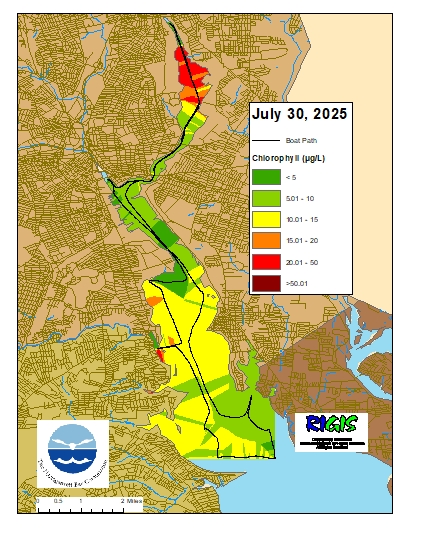
July 30, 2025

Surface chlorophyll data were collected on July 30, 2025, while the R/V Monitor was underway collecting nutrient samples in the Providence and Seekonk River estuary. The average chlorophyll concentrations were categorized as fair in all individual areas surveyed as well as in the overall survey area. Overall, chlorophyll ranged from 1.1 µg/L to 46.06 µg/L with an average of 10.06 µg/L. The chlorophyll concentrations from this date are presented in the map below using Inverse Distance Weighting (IDW) interpolation. 

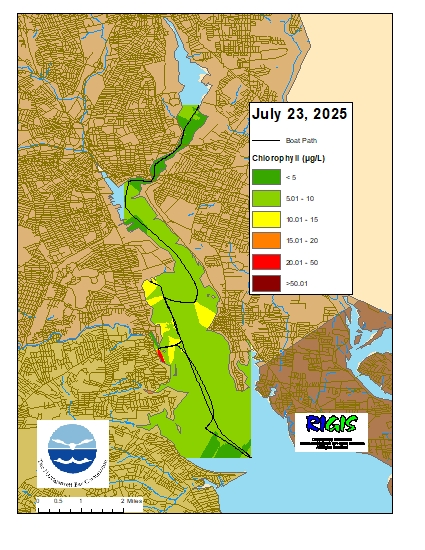
July 23, 2025

Surface chlorophyll data were collected on July 23, 2025, while the R/V Monitor was underway collecting nutrient samples in the Providence and Seekonk River estuary. The average chlorophyll concentrations were categorized as good in the Seekonk River, and as fair in all other areas. The average chlorophyll concentrations were categorized as fair over all areas surveyed. Overall, chlorophyll ranged from 2.85 µg/L to 28.47 µg/L with an average of 7.25 µg/L. The chlorophyll concentrations from this date are presented in the map below using Inverse Distance Weighting (IDW) interpolation.

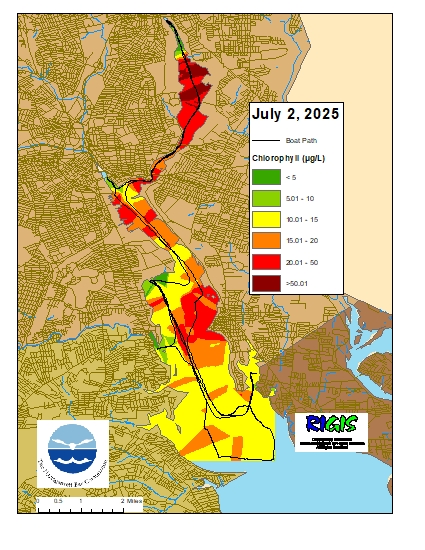
July 2, 2025

Surface chlorophyll data were collected on July 2, 2025, while the R/V Monitor was underway collecting nutrient samples in the Providence and Seekonk River estuary. The average chlorophyll concentrations were categorized as poor in the Seekonk River, and as fair in all other areas. The average chlorophyll concentrations were categorized as fair over all areas surveyed. Overall, chlorophyll ranged from 1.47 µg/L to 145.88 µg/L with an average of 17.45 µg/L. The chlorophyll concentrations from this date are presented in the map below using Inverse Distance Weighting (IDW) interpolation. 

July 30, 2025

Water column profiles were conducted at eight locations in the Providence and Seekonk River estuaries on July 30, 2025 using a Seabird Electronics profiler. In the five days leading up to the survey, 1.91 inches of precipitation were recorded at T.F. Green.  Water column stratification varied between the sites this week from weakly stratified to moderately stratified.

Dissolved oxygen (DO) conditions were below the hypoxia threshold (2.9 mg/L) in the middle portion of the water column at Pomham Rocks, in the middle and lower portions of the water column at India Point Park, Edgewood Yacht Club, Pawtuxet Cove, and Phillipsdale Landing, and in all portions of the water column at Point Street Bridge. The highest fluorescence readings for the week were measured around 1 meter below the surface at Phillipsdale Landing.

July 30, 2025

Water clarity was measured at eight locations in the Providence River and Seekonk River estuaries on July 30, 2025. In the five days prior to the survey, 1.91 inches of precipitation were recorded at TF Green. Secchi depth averaged 2.2 meters. The lowest clarity this week (1.5 meters) was measured at Phillipsdale Landing and Pawtuxet Cove, while the greatest clarity (3.7 meters) was measured at Point Street Bridge. There was no clear north-to-south gradient in water clarity among the sites this week. Overall, water clarity remained approximately the same from the previous measurements (data collected July 23, 2025).

May 26 – June 1, 2025

Phillipsdale Landing

Overall, water quality at Phillipsdale Landing was good this week. Weather conditions were slightly dryer this week than previous weeks, with a total of 0.53 inches recorded at T.F. Green, and the majority of rainfall occurring on the 31st.  The Blackstone River flow decreased throughout the week, but remained above the 20-year daily median for the entire week. Salinity at the surface averaged 4.4 ppt and ranged from 1.4 ppt to 15.6 ppt. At the bottom, salinity averaged 11.1 ppt and ranged from 2.0 ppt to 26.4 ppt. Temperatures this week averaged 17.0 °C at the surface and 16.0 °C at the bottom. Surface temperatures ranged from 13.2 °C to 19.5 °C, while bottom temperatures ranged from 12.6 °C to 19.3 °C.

Dissolved oxygen (DO) at Phillipsdale Landing remained above the hypoxia threshold (i.e., DO >2.9 mg/L) throughout the week. Surface DO averaged 8.8 mg/L and ranged from 6.8 -10.4 mg/L. Bottom water DO concentration averaged 7.8 mg/L and ranged from 5.5 mg/L to 10.4 mg/L. Chlorophyll was low, averaging 1.5 ug/L at the surface and 1.8 ug/L at the bottom. Maximum surface chlorophyll readings reached 4.4 ug/L in the early morning of May 31st. Please note that tidal fluctuations and Blackstone River flows greatly influence water column salinity, temperature, and DO at this location.

Bullock Reach

The Bullock Reach Buoy remains out of the water for the winter.  EM will coordinate with RIDEM to redeploy the buoy in late spring-early summer.
May 19 – May 25, 2025

Phillipsdale Landing

Overall, water quality at Phillipsdale Landing was fair to good this week. Weather conditions were wet this week, with a total of 2.31 inches recorded at T.F. Green, and the majority of rainfall occurring on the 26th.  The Blackstone River flow peaked on the 23rd and 24th, but remained above the 20-year daily median for the entire week. Salinity at the surface averaged 5.4 ppt and ranged from 0.3 ppt to 12.7 ppt. At the bottom, salinity averaged 12.3 ppt and ranged from 0.1 ppt to 37.2 ppt; however, the salinity data for the first part of the week also exhibits some anomalous behavior, and may be tied to a sensor malfunction. Temperatures this week averaged 14.6 °C at the surface and 13.7 °C at the bottom. Surface temperatures ranged from 12.0 °C to 19.1 °C, while bottom temperatures ranged from 12.2 °C to 18.0 °C.

Dissolved oxygen (DO) at Phillipsdale Landing remained above the hypoxia threshold (i.e., DO >2.9 mg/L) throughout the week. Surface DO averaged 9.2 mg/L and ranged from 7.1 -11.4 mg/L. Bottom water DO concentration averaged 7.6 mg/L and ranged from 3.4 mg/L to 11.3 mg/L. Chlorophyll was low, averaging 1.1 ug/L at the surface and 1.5 ug/L at the bottom. Maximum surface chlorophyll readings reached 2.4 ug/L. Please note that tidal fluctuations and Blackstone River flows greatly influence water column salinity, temperature, and DO at this location.

The bottom sonde had a malfunctioning depth sensor, thus no depth data is available for the bottom sonde until the sondes were swapped out on May 20th.

Bullock Reach

The Bullock Reach Buoy remains out of the water for the winter.  EM will coordinate with RIDEM to redeploy the buoy in late spring-early summer.
​May 12 – May 18, 2025

Phillipsdale Landing

Overall, water quality at Phillipsdale Landing was fair to good this week. Weather conditions were wet this week, with a total of 1.38 inches recorded at T.F. Green, and the majority of rainfall occurring on the 15th.  The Blackstone River flow peaked on the 16th and remained above the 20-year daily median for the entire week. Salinity at the surface averaged 1.8 ppt and ranged from 0.4 ppt to 4.2 ppt. At the bottom, salinity averaged 9.1 ppt and ranged from 0.0 ppt to 32.8 ppt; however, the salinity data for the first part of the week also exhibits some anomalous behavior, and may be tied to a sensor malfunction. Temperatures this week averaged 18.2 °C at the surface and 16.1 °C at the bottom. Surface temperatures ranged from 14.7 °C to 20.6 °C, while bottom temperatures ranged from 11.8 °C to 20.1 °C.

Dissolved oxygen (DO) at Phillipsdale Landing remained above the hypoxia threshold (i.e., DO >2.9 mg/L) throughout the week. Surface DO averaged 9.0 mg/L and ranged from 7.8 -10.4 mg/L. Bottom water DO concentration averaged 7.1 mg/L and ranged from 3.9 mg/L to 9.9 mg/L. Chlorophyll was low, averaging 0.9 ug/L at the surface and 2.7 ug/L at the bottom. Maximum surface chlorophyll readings reached 3.7 ug/L, recorded on the afternoon of May 12th. Please note that tidal fluctuations and Blackstone River flows greatly influence water column salinity, temperature, and DO at this location.

The bottom sonde had a malfunctioning depth sensor this week, thus no depth data is available for the bottom sonde. The salinity data for this week also exhibits some anomalous behavior, and may have been malfunctioning.

Bullock Reach

The Bullock Reach Buoy remains out of the water for the winter.  EM will coordinate with RIDEM to redeploy the buoy in late spring-early summer.

Scroll to Top