
Phytoplankton samples were collected on June 10, 2026 at Bullock’s Reach and analyzed in the laboratory shortly after collection.
On this day, the water temperature was 20.03 °C, the salinity was 27.2 PSU, and the chlorophyll a was 1.54 ug/L.
The qualitative tow net sample had a long filtration time and was cloudy and light golden brown in coloration.
The analysis of the quantitative whole water sample revealed a total of 5,570,000 cells/L. The microflagellates were found at 515,000 cells/L. The most predominant phytoplankton genera were Dactyliosolen spp. at 4,650,000 cells/L, Skeletonema spp. at 250,000 cells/L, and Chaetoceros spp. at 120,000 cells/L.
200x phase contrast image of Peridinium spp.
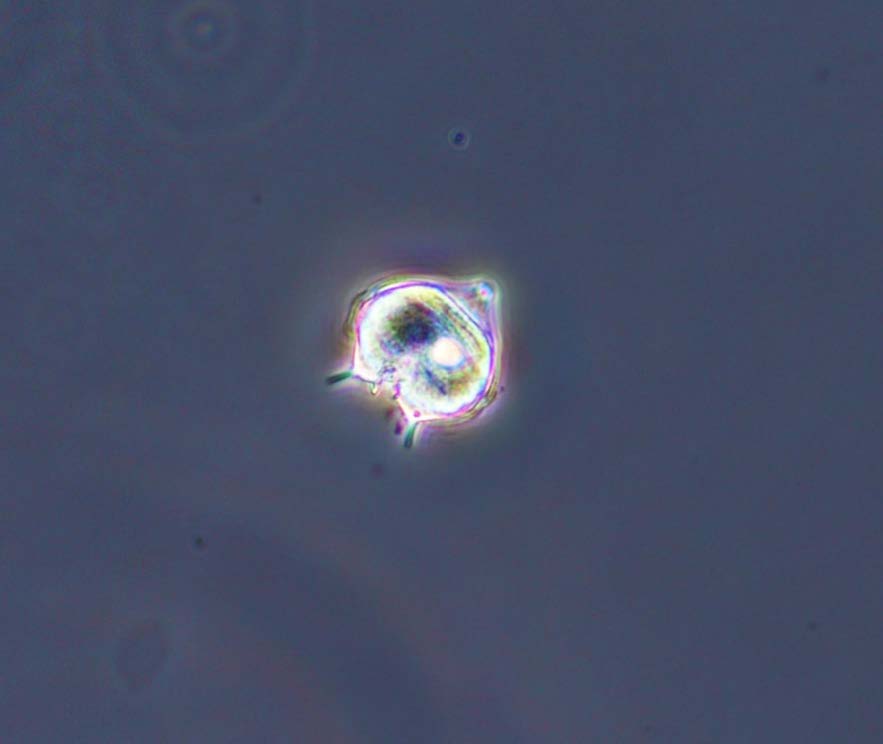
Peridinium spp. are cosmopolitan dinoflagellates mostly found in freshwater lakes, ponds and pools. Some inhabit brackish environments. This genus was originally described in the early 1830s, making it one of the first known groups of dinoflagellates. They are thought to be mixotrophic, which means they obtain energy through photosynthesis (autotrophy), and ingestion of small organisms (heterotrophy).