August 20-26, 2023

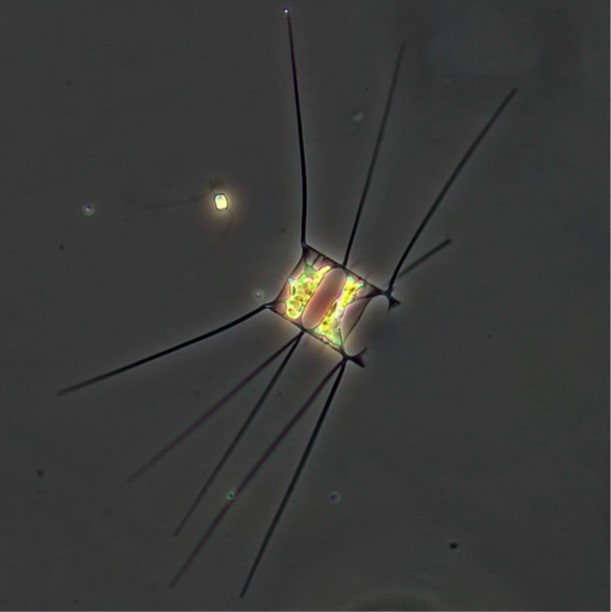
Phytoplankton samples were collected on August 23, 2023 at Bullock Reach and analyzed in the laboratory shortly after collection. Sonde data revealed the surface water temperature was 21.0°C and salinity was 26.5 psu. The plankton tow net sample was filterable with a 20 micron mesh. The filtrate was a light brown color and had a quick filter time. The tow net sample was analyzed qualitatively for microorganisms using phase contrast microscopy. The whole water sample was analyzed quantitatively under 200x phase contrast microscopy. A Hensen Stempel pipette was used to accurately deliver 1ml of sample to a Sedge-wick Rafter chamber. This analysis revealed a total of 1,866,000 cells per Liter. The micro flagellates were found at 348,000 cells/L. The most predominant phytoplankton genus was Leptocylindrus spp.at 948,000 cells/L. Other representative genera include Skeletonema spp., Chaetoceros spp. (see 200x phase contrast image below), and Guinardia spp.
August 1, 2024

​Water column profiles were conducted at seven locations in the Providence and Seekonk River estuaries on August 1, 2024 using a Seabird Electronics profiler. In the five days leading up to the survey, 1.34 inches of precipitation were recorded at T.F. Green. Water column stratification at the sites varied from well-mixed at Edgewood Yacht Club, to strongly stratified at Point Street Bridge. 

Dissolved oxygen (DO) conditions were below the hypoxia threshold (2.9 mg/L) in the lower portion of the water column at Point Street Bridge and Pomham Rocks, and in the upper and middle portions of the water column at Phillipsdale Landing. The highest fluorescence readings for the week were measured around 1.5 meters below the surface at Phillipsdale Landing.​

July 24, 2024

​Water column profiles were conducted at eight locations in the Providence and Seekonk River estuaries on July 24, 2024 using a Seabird Electronics profiler. In the five days leading up to the survey, 0.06 inches of precipitation were recorded at T.F. Green. Water column stratification at the sites varied from well-mixed at Pawtuxet Cove and Phillipsdale Landing, to moderately stratified at sites such as Bullock Reach Buoy and India Point Park. 

Dissolved oxygen (DO) conditions were below the hypoxia threshold (2.9 mg/L) in the lower portion of the water column at the Bullock Reach Buoy, and in the lower and middle portions of the water column at the Pomham Rocks, India Point Park, Edgewood Yacht Club, and Edgewood Shoals sites. The highest fluorescence readings for the week were measured around 1.5 meters below the surface at Pawtuxet Cove.

July 17, 2024

​Water column profiles were conducted at seven locations in the Providence and Seekonk River estuaries on July 17, 2024 using a Seabird Electronics profiler. In the five days leading up to the survey, 0.48 inches of precipitation were recorded at T.F. Green. Water column stratification at the sites varied from weakly stratified at Point Street Bridge, to strongly stratified at a majority of sites, including Bullock Reach Buoy and Phillipsdale Landing. 

Dissolved oxygen (DO) conditions were below the hypoxia threshold (2.9 mg/L) in the lower portion of the water column at the Bullock Reach Buoy and Edgewood Yacht Club sites, in the lower and middle portions of the water column at the Pomham Rocks and Phillipsdale Landing sites, and in all portions of the water column (upper, middle, and lower) at India Point Park. DO conditions were below the hypoxia threshold at Conimicut Point only in the middle portion of the water column. The highest fluorescence readings for the week were measured around 1 meter below the surface at Phillipsdale Landing.

Week of August 20 – 26, 2023

​Nutrient samples were collected from fourteen river stations and eight bay stations on August 23rd, 2023. Edgewood Shoal was sampled at the surface and bottom; all other bay stations were sampled at the surface only. In the five days prior to sampling, there were 2.16 inches of rainfall recorded at T.F. Green due to a heavy rain event on August 18th.

Among the river stations sampled, the highest total nitrogen (TN) concentration was observed at Pawtuxet River @ Broad Street (TN = 1,815 ppb, average of duplicates), while the highest total dissolved nitrogen (TDN) and dissolved inorganic nitrogen (DIN) concentrations were at Ten Mile River @ Central Ave. (TDN = 1,480 ppb, DIN = 1,013.9 ppb). The lowest TN and TDN were observed at Ten Mile River @ Roger Williams Ave. (TN = 510 ppb, TDN = 666 ppb), while the lowest DIN was at Coles River @ Milford Rd. (97.4 ppb, average of duplicates).

Among the bay stations sampled, the highest surface TN, TDN, and DIN were observed at Pawtuxet Cove (TN = 1,020 ppb, TDN = 892 ppb, DIN = 662.3 ppb). The lowest surface TN and DIN were observed at the Bullock Reach Buoy (TN = 540 ppb, DIN = 119.5 ppb), while the lowest surface TDN was at Conimicut Point (276 ppb). Chlorophyll a concentrations at the surface bay stations averaged 3.95 μg/L overall with a maximum of 7.02 μg/L at Conimicut Point.

April 16, 2024

​Water column profiles were conducted at seven locations in the Providence and Seekonk River estuaries on April 16, 2024 using a Seabird Electronics profiler. In the five days leading up to the survey, 1.01 inches of precipitation were recorded at T.F. Green. Most sites were strongly stratified this week, with the exception of Phillipsdale Landing, which was dominated by freshwater.

Dissolved oxygen (DO) conditions were not observed to be below the hypoxia threshold (2.9 mg/L) at any site profiled this week. The highest fluorescence readings for the week were measured around 10 meters below the surface at Pomham Rocks.

August 13-19, 2023

​Water clarity was measured at five locations in the Providence River and Seekonk River estuaries on August 16. Rainfall totaling 0.61 inches was recorded at TF Green in the five days prior to the survey. Secchi depth averaged 2.8 meters, compared to 1.8 meters on the previous survey (August 9). The lowest clarity this week (1.9 meters) was measured at Phillipsdale Landing, while the greatest clarity (3.6 meters) was measured at Point St. Bridge. There was no clear north-to-south gradient in water clarity among the sites this week.

August 13-19, 2023

On August 16, twenty stations were sampled for fecal coliform bacteria in the Providence and Seekonk Rivers.  Five of these stations were also sampled for enterococci bacteria. Precipitation in the five days prior to sampling totaled 0.61 inches as recorded at TF Green.

The geometric mean of fecal coliform results for all sites was 149 MPN/100 mL compared to 41 MPN/100 mL on August 2. Overall, bacteria counts were higher in both the Seekonk and Providence Rivers this week than during the previous sampling event on August 2. Fecal coliform counts were geomeans of 435 MPN/ 100 mL in the Seekonk River and 90 MPN/ 100 mL in the Providence River. The maximum count (9300 MPN/100 mL) was measured at Bullock Reach Buoy in the Providence River.

Enterococci results had an overall geometric mean of 35 MPN/100 mL. Enterococci counts ranged from non-detect at a Gaspee Point and Conimicut Point to 238 MPN/100 mL at Point St. Bridge.

The table below lists the Rhode Island bacteria standards for primary contact and shellfishing established by the Rhode Island Department of Environmental Management (RIDEM). RIDEM defines primary contact as any recreational activities in which there is prolonged and intimate contact with water, involving considerable risk of ingesting water (e.g., swimming, diving, water skiing and surfing). Please note that the RIDEM bacteria standards are provided here for informational purposes only and are not intended to indicate official state compliance with primary contact or shellfishing standards.

Summary of Rhode Island Bacteria Standards for Saltwater Primary Contact and Shellfishing

 ​​Fecal Coli​fo​rmEnterococci
Primary Con​​​t​a​c​t1​​​​​Geom​e​tric me​a​n​ ≤50 MPN/1​​00​ mL
<10% ​o​f​​ samples >400 MPN/100 ​mL
Geom​etric mean ≤35 colo​nies/100 mL​
All sa​mples ≤104 colonies/100 ​​mL2
ShellfishingGeometric mean ≤14 MPN/100​ mL
<10% of samples >49 MPN/100 mL3​
NO ENTEROCOCCI CR​ITERIA

1Fecal coliform primary contact criteria app​lied only when adequate enterococci data are not available; 2Single sample maximum criterion for determining beach swimming advisories at designated beaches as evaluated by the Rhode Island Department of Health; 3For a three-tube decimal dilution

Table adapted from Rhode Island Water Quality Regulations (250-RICR-150-05-1)​; see regulations for complete details.​​​​​​​​​​

August 13-19, 2023

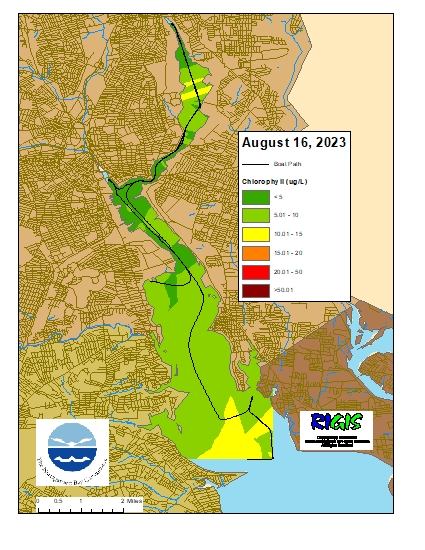
Surface chlorophyll data were collected on August 16, 2023 while the R/V Monitor was underway collecting nutrient samples in the Providence and Seekonk River estuaries. The average chlorophyll concentrations were categorized as good in the Seekonk River and Northern Providence River Channel and as fair in all others. Overall, chlorophyll ranged from 1.46 to 17.84 µg/L with an average of 5.21 µg/L. The chlorophyll concentrations from this date are presented in the map below using Inverse Distance Weighting (IDW) interpolation.

*Due to file error the lowest portion of the boat path for this survey is not displayed.

March 20, 2024

​Water column profiles were conducted at seven locations in the Providence and Seekonk River estuaries on March 20, 2024 using a Seabird Electronics profiler. In the five days leading up to the survey, 0.08 inches of precipitation were recorded at T.F. Green. Most sites were strongly or moderately stratified this week, with the exception of Phillipsdale Landing, which was dominated by freshwater.

Dissolved oxygen (DO) conditions were not observed to be below the hypoxia threshold (2.9 mg/L) at any site profiled this week. The highest fluorescence readings for the week were measured around 2 meters below the surface at Bullock Reach Buoy.

Scroll to Top