May 12, 2026

Water column profiles were conducted using a Seabird Electronics profiler at seven locations in the Providence River and one location in the Seekonk River on May 12, 2026. In the four days leading up to and including the survey day, there were 0.34 inches of rain recorded at T.F. Green International Airport (Warwick, RI). The water column was strongly stratified at Conimicut Point, Bullock’s Reach, Pomham Rocks, Phillipsdale Landing, and India Point Park, and weakly stratified at Edgewood Shoal, Edgewood Yacht Club, and Pawtuxet Cove.

Dissolved oxygen conditions were not below the hypoxia threshold (2.9 mg/L) at any of the visited locations. The highest fluorescence reading was observed about 3.25 meters below the surface at Conimicut Point.

May 7, 2026

Water column profiles were conducted using a Seabird Electronics profiler at seven locations in the Providence River and one location in the Seekonk River on May 7, 2026. In the four days leading up to and including the survey day, there were 0.26 inches of rain recorded at T.F. Green International Airport (Warwick, RI). The water column was strongly stratified at Pawtuxet Cove and Phillipsdale Landing, and moderately stratified at Bullock’s Reach, Conimicut Point, India Point Park, Pomham Rocks, Edgewood Yacht Club, and Point St. Bridge.

Dissolved oxygen conditions were not below the hypoxia threshold (2.9 mg/L) at any of the visited locations. The highest fluorescence reading was observed about 2.5 meters below the surface at Pomham Rocks.

May 12, 2026

Phytoplankton samples were collected on May 12, 2026 at Bullock’s Reach and analyzed in the laboratory shortly after collection.

On this day, the water temperature was 13.60 °C, the salinity was 22.93 PSU, and the chlorophyll a was 8.36 µg/L.

It was sunny and clear on this day. The qualitative tow net sample had a short filtration time and contained a large volume of copepods.

The analysis of the quantitative whole water sample revealed a total of 749,000 cells/L. The microflagellates were found at 673,000 cells/L. The most predominant phytoplankton genera were Silicoflagellate spp. at 40,000 cells/L, Skeletonema spp. at 13,000 cells/L, and Unknown Diatom spp. at 10,000 cells/L.

200x phase contrast image of Pediastrum spp.

Pediastrum is a genus of freshwater green algae found in lakes, ponds and along shores where water is rich in nutrients such as nitrogen. They are nonmotile and form flat colonies with concentric rings that resemble snowflakes. These groupings can both improve their buoyancy in the water column and help prevent predation.

April 29, 2026

Phytoplankton samples were collected on April 29, 2026 at Bullock Reach and analyzed in the laboratory shortly after collection.

On this day, the water temperature was 10.70 °C, the salinity was 24.63 PSU.

The qualitative tow net sample had a moderate filtration time. The filtrate was cloudy and reddish brown with some darker particulates.

The analysis of the quantitative whole water sample revealed a total of 2,224,000 cells/L. The microflagellates were found at 194,000 cells/L. The most predominant phytoplankton genera were Skeletonema spp. at 1,694,000 cells/L, Thalassiosira spp. at 128,000 cells/L, and Chaetoceros spp.at 92,000 cells/L.

200x phase contrast image of Asterionellopsis spp.

Asterionellopsis is a genus of neritic pennate diatom found in cold to temperate coastal waters. Their cells have two chloroplasts each and are joined by valve faces into star-shaped or spiraling chains.

April 15, 2026

Phytoplankton samples were collected on April 15, 2026 at Bullock Reach and analyzed in the laboratory shortly after collection.

It was sunny with light wind on this day. The water temperature was 12.66 °C, the salinity was 19.05 PSU, and the chlorophyll a was 15.54 ug/L.

The qualitative tow net sample had a moderate filtration time. The filtrate was cloudy and reddish brown.

The analysis of the quantitative whole water sample revealed a total of 37,240,000 cells/L. The microflagellates were found at 320,000 cells/L. The most predominant phytoplankton genera were Skeletonema spp. at 33,763,000 cells/L, Chaetoceros spp. at 1,653,000 cells/L, and Leptocylindrus spp. at 765,000 cells/L.

200x phase contrast image of Thalassiosira spp.

Thalassiosira is a large genus of mostly marine diatoms which are known for their bloom formations. They are responsible for significant algal blooms worldwide in temperate, boreal, and polar regions, particularly in layers underlying sea ice and in upwelling areas.

May 20, 2026

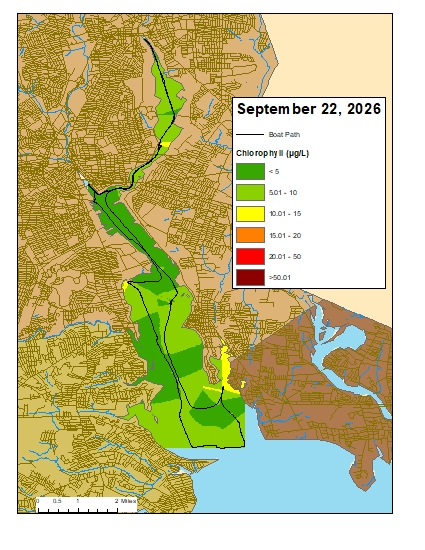
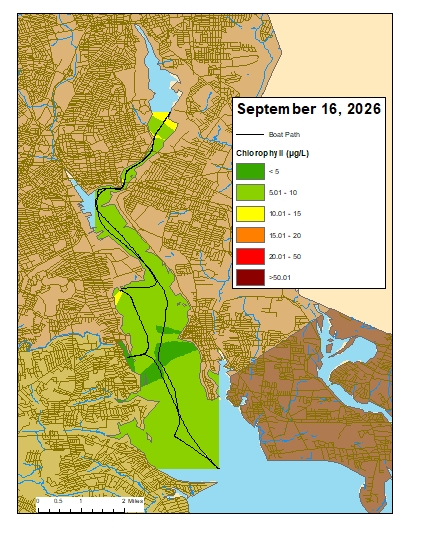
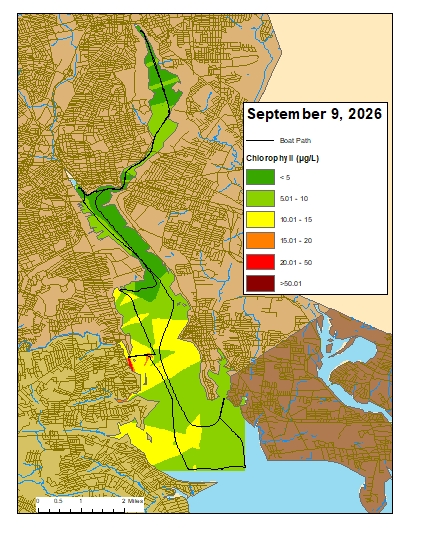
Surface chlorophyll data were collected on May 20, 2026, while the R/V Data Stream was underway collecting bacteria samples in the Providence and Seekonk River Estuaries. The average chlorophyll concentrations were categorized as fair in all areas. The average chlorophyll concentrations were also categorized as fair over all areas surveyed. Overall, chlorophyll ranged from 0.97 µg/L to 120.89 µg/L with an average of 6.97 µg/L. The chlorophyll concentrations from this date are presented in the map below using Inverse Distance Weighting (IDW) interpolation.

May 7, 2026

Surface chlorophyll data were collected on May 7, 2026, while the R/V Data Stream was underway collecting bacteria samples in the Providence and Seekonk River Estuaries. The average chlorophyll concentrations were categorized as good in all areas. The average chlorophyll concentrations were categorized as good to fair over all areas surveyed. Overall, chlorophyll ranged from 1.60 µg/L to 13.44 µg/L with an average of 4.63 µg/L. The chlorophyll concentrations from this date are presented in the map below using Inverse Distance Weighting (IDW) interpolation.

May 19, 2026

Water clarity was measured at seven locations in the Providence River and Seekonk River estuaries on May 19, 2026. In the five days prior to the survey, 0.11 inches of precipitation were recorded at TF Green. Secchi depth averaged 2.9 meters. The lowest clarity this week (1.9 meters) was measured at Phillipsdale Landing, while the greatest clarity (3.7 meters) was measured at Bullock Reach and Conimicut Point. There was a general north-to-south trend of increasing water clarity among the sites this week. Overall, water clarity increased from the previous measurements (data collected May 12, 2026).

May 12, 2026

Water clarity was measured at eight locations in the Providence River and Seekonk River estuaries on May 12, 2026. In the five days prior to the survey, 0.57 inches of precipitation were recorded at TF Green. Secchi depth averaged 2.1 meters. The lowest clarity this week (1.9 meters) was measured at Bullock Reach and Edgewood Shoal, while the greatest clarity (2.5 meters) was measured at Pawtuxet Cove. There was no clear north-to-south gradient in water clarity among the sites this week. Overall, water clarity decreased from the previous measurements (data collected May 7, 2026).

May 7, 2026

Water clarity was measured at eight locations in the Providence River and Seekonk River estuaries on May 7, 2026. In the five days prior to the survey, 0.05 inches of precipitation were recorded at TF Green. Secchi depth averaged 3.0 meters. The lowest clarity this week (1.7 meters) was measured at Phillipsdale Landing, while the greatest clarity (4.3 meters) was measured at Conimicut Point. There was a general north-to-south trend of increasing water clarity among the sites this week.

Scroll to Top