Phytoplankton samples were collected on March 6, 2024 at Bullock Reach and analyzed in the laboratory shortly after collection. It was cloudy and mild on Narragansett Bay with an outgoing tide. The qualitative tow net sample had a moderate filter time, and the filtrate was a golden brown color.
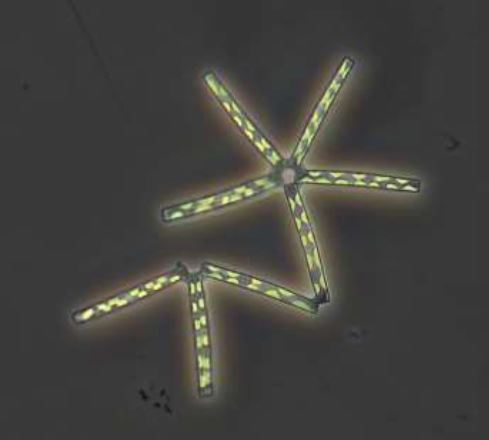
The analysis of the quantitative whole water sample revealed a total of 24,820,000 cells per Liter. The micro flagellates were found at 40,000 cells/L. The most predominant phytoplankton genus was Leptocylindrus spp. at 3,840,000 cells/L. Other representative genera include Skeletonema spp. and Chaetoceros spp. Thalassionema nitzschioides (today’s featured micrograph, 200x phase contrast) is a type of phytoplankton belonging to the pennate diatom group. This photosynthetic species has small and numerous chloroplasts which give it a yellow brown color. The cells are usually found in star-shaped or in zigzagged chains. They occur in waters with salinity between 12-38 ppt and 15°C.
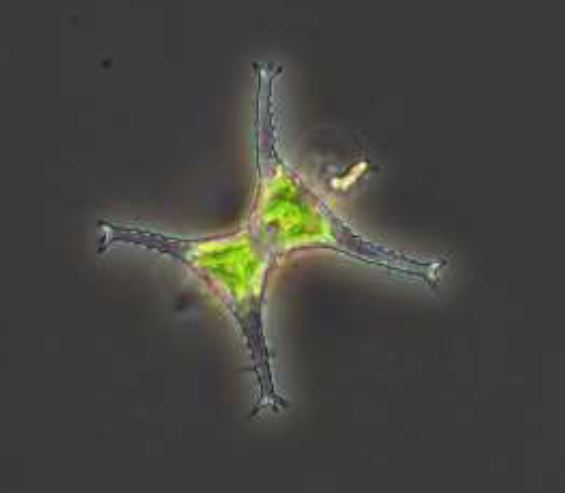
Phytoplankton samples were collected on December 13, 2023 at Bullock’s Reach and analyzed in the laboratory shortly after collection. It was calm and brisk on Narragansett Bay with an outgoing tide. The qualitative tow net sample had a moderate filter time, and the filtrate was a light brown color with some particulate matter. The analysis of the quantitative whole water sample revealed a total of 81,000 cells per liter. The micro flagellates were found at 11,000 cells/L. The most predominant phytoplankton genus was Skeletonema spp. at 31,000 cells/L. Other representative genera include Leptocylindrus spp. and Guinardia spp. The photo featured this week is a 200x phase-contrast image of Staurastrum, a type of green algae in the desmid family. It gets its name from the Greek “stauron” which means cross and “astron” which means star. It is made of highly constricted unicells that are radially symmetrical and can be distinguished by cell wall patterns. Staurastrum is a food source for zooplankton in the aquatic food web.
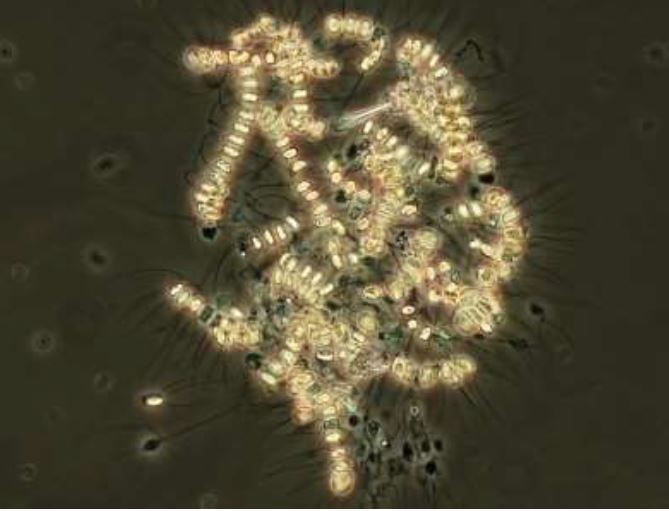
Phytoplankton samples were collected on November 30, 2023 at Bullock Reach and analyzed in the laboratory shortly after collection. It was sunny and brisk on Narragansett Bay with calm conditions and a southwest wind at less than 10 kts. The qualitative tow net sample had a quick filter time, and the filtrate was a light tan color. The analysis of the quantitative whole water sample revealed a total of 153,000 cells per liter. The microflagellates were found at 52,000 cells/L. The most predominant phytoplankton genus was Skeletonema spp. at 65,000 cells/L. Other representative genera include Chaetoceros spp. and Eucampia spp. Chaetoceros socialis (see image, 200x phase contrast) is a diatomic phytoplankton found in marine and brackish waters. These phytoplankton have a characteristic linear colonial growth habit and their very long, overlapping, spines are thought to minimize sinking rates.
Phytoplankton whole water sample was collected on November 15, 2023 at Bullock Reach and analyzed in the laboratory shortly after collection. No qualitative tow-net sample was collected this day. It was calm, clear, and very brisk on Narragansett Bay with clear water about 6.2 meters down. Sonde data revealed the surface water temperature was 10.4°C, salinity was 24.8 psu, and chlorophyll a was 0.8 ug/L. The analysis of the quantitative whole water sample revealed a total of 77,000 cells per Liter. The microflagellates were found at 39,000 cells/L. The most predominant phytoplankton genus was Skeletonema spp. at 13,000 cells/L. Other representative genera include Leptocylindrus spp., Chaetoceros spp. and Pseudo-nitzchia spp.
Water clarity was measured at eight locations in the Providence River and Seekonk River estuaries on March 6, 2024. Rainfall totaling 3.16 inches was recorded at TF Green in the five days prior to the survey. Secchi depth averaged 2.9 meters. The lowest clarity this week (2.3 meters) was measured at Phillipsdale Landing, while the greatest clarity (3.7 meters) was measured at Conimicut Point. There was no evidence of a north-to-south gradient of increasing water clarity among the sites this week.
Water clarity was measured at seven locations in the Providence River and Seekonk River estuary on May 14th, 2024. Rainfall totaling 0.1 inches was recorded at TF Green in the five days prior to the survey. Secchi depth averaged 2.4 meters, compared to 1.3 meters on the previous survey (December 13th). The lowest clarity this week (1.4 meters) was measured at Phillipsdale Landing, while the greatest clarity (3.4 meters) was measured at Bullock’s Reach. There was a general north-to-south gradient of increasing water clarity among the sites this week.
Water clarity was measured at seven locations in the Providence River and Seekonk River estuary on May 22nd, 2024. Rainfall totaling 0.27 inches was recorded at TF Green in the five days prior to the survey. Secchi depth averaged 2.1 meters, compared to 2.4 meters on the previous survey (May 14th). The lowest clarity this week (1.0 meters) was measured at Phillipsdale Landing, while the greatest clarity (3.2 meters) was measured at Conimicut Point. There was a general north-to-south gradient of increasing water clarity among the sites this week.
Phytoplankton samples were collected on November 1, 2023 at Bullock Reach and analyzed in the laboratory shortly after collection. It was cloudy and brisk on Narragansett Bay with a northwest wind at 10 kts. Sonde data revealed the surface water temperature was 13.08°C, salinity was 22.63 psu, and chlorophyll a was 1.06
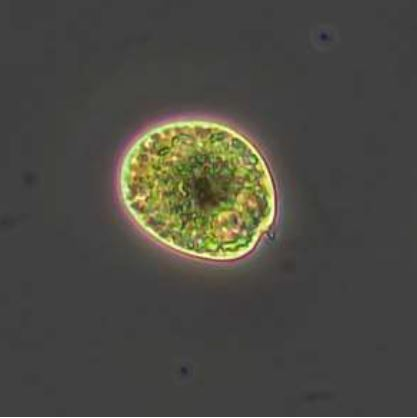
ug/L. The qualitative tow net sample had a moderate filter time, and the filtrate was a light yellow-brown color. The analysis of the quantitative whole water sample revealed a total of 119,000 cells per liter. The micro flagellates were found at 62,000 cells/L. The most predominant phytoplankton genus was Skeletonema spp. at 46,000 cells/L. Other representative genera include Leptocylindrus spp., Eucampia spp., and Prorocentrum spp. Prorocentrum micans (see image, 200x phase contrast) is a tear-dropped shaped dinoflagellate that is often found in Narragansett Bay during the late summer-autumn time period. This species can form extensive blooms but is considered harmless.
On March 27th, twenty stations were sampled for fecal coliform bacteria in the Providence and Seekonk Rivers; five of these stations were also sampled for enterococci bacteria. In the five days prior to sampling, precipitation totaled 3.12 inches as recorded at TF Green. Overall, bacteria counts were higher in both the Seekonk and Providence Rivers this week than during the previous sampling event on March 13th, likely because this event had less time in between the rainfall and sampling.
Fecal coliform counts were slightly lower in the Seekonk River sites than in the Providence River sites (geometric means of 51 MPN/100 mL and 66 MPN/100 mL, respectively). The maximum count (430 MPN/100 mL) was measured at both Collier Point Park and Off FP Outfall.
Enterococci results had an overall geometric mean of 26 MPN/100 mL. Enterococci counts ranged from 20 MPN/100 mL at South FP East to 41 MPN/100 mL at both Phillipsdale Landing and Gaspee Point.
The table below lists the Rhode Island bacteria standards for primary contact and shellfishing established by the Rhode Island Department of Environmental Management (RIDEM). RIDEM defines primary contact as any recreational activities in which there is prolonged and intimate contact with water, involving considerable risk of ingesting water (e.g., swimming, diving, water skiing and surfing). Please note that the RIDEM bacteria standards are provided here for informational purposes only and are not intended to indicate official state compliance with primary contact or shellfishing standards.
Summary of Rhode Island Bacteria Standards for Saltwater Primary Contact and Shellfishing
Geometric mean ≤35 colonies/100 mL All samples ≤104 colonies/100 mL2
Shellfishing
Geometric mean ≤14 MPN/100 mL <10% of samples >49 MPN/100 mL3
NO ENTEROCOCCI CRITERIA
1Fecal coliform primary contact criteria applied only when adequate enterococci data are not available; 2Single sample maximum criterion for determining beach swimming advisories at designated beaches as evaluated by the Rhode Island Department of Health; 3For a three-tube decimal dilution
On March 13th, twenty stations were sampled for fecal coliform bacteria in the Providence River and Seekonk River; five of these stations were also sampled for enterococci bacteria. In the five days prior to sampling, precipitation totaled 2.32 inches as recorded at TF Green.
Fecal coliform counts were slightly lower in the Seekonk River sites than in the Providence River sites (geometric means of 29 MPN/100 mL and 33 MPN/100 mL, respectively). The maximum count (430 MPN/100 mL) was measured at Point Street Bridge.
Enterococci results had an overall geometric mean of 12 MPN/100 mL. Enterococci counts ranged from non-detect at most sites to a max of 31 MPN/100 mL at Point Street Bridge.
The table below lists the Rhode Island bacteria standards for primary contact and shellfishing established by the Rhode Island Department of Environmental Management (RIDEM). RIDEM defines primary contact as any recreational activities in which there is prolonged and intimate contact with water, involving considerable risk of ingesting water (e.g., swimming, diving, water skiing and surfing). Please note that the RIDEM bacteria standards are provided here for informational purposes only and are not intended to indicate official state compliance with primary contact or shellfishing standards.
Summary of Rhode Island Bacteria Standards for Saltwater Primary Contact and Shellfishing
Geometric mean ≤35 colonies/100 mL All samples ≤104 colonies/100 mL2
Shellfishing
Geometric mean ≤14 MPN/100 mL <10% of samples >49 MPN/100 mL3
NO ENTEROCOCCI CRITERIA
1Fecal coliform primary contact criteria applied only when adequate enterococci data are not available; 2Single sample maximum criterion for determining beach swimming advisories at designated beaches as evaluated by the Rhode Island Department of Health; 3For a three-tube decimal dilution