Evan Thompson

June 17, 2024

On June 17th, seventeen stations were sampled for fecal coliform bacteria in the Providence and Seekonk Rivers; five of these stations were also sampled for enterococci bacteria. In the five days prior to sampling, precipitation totaled 0.06 inches as recorded at TF Green.

Overall, bacteria counts were lower in both the Seekonk and Providence Rivers than during the previous sampling event.

Fecal coliform counts were higher in the Seekonk River sites than in the Providence River sites (geometric means of 135 MPN/100 mL and 52 MPN/100 mL, respectively). The maximum count (430 MPN/100 mL) was measured at Collier Point Park. 

Enterococci results had an overall geometric mean of 18 MPN/100 mL. Enterococci counts ranged from <10 MPN/100 mL at Gaspee Point and Conimicut Point to 98 MPN/100 mL at Point St Bridge.

The next scheduled sampling date is July 3.

The table below lists the Rhode Island bacteria standards for primary contact and shellfishing established by the Rhode Island Department of Environmental Management (RIDEM). RIDEM defines primary contact as any recreational activities in which there is prolonged and intimate contact with water, involving considerable risk of ingesting water (e.g., swimming, diving, water skiing and surfing). Please note that the RIDEM bacteria standards are provided here for informational purposes only and are not intended to indicate official state compliance with primary contact or shellfishing standards.

Summary of Rhode Island Bacteria Standards for Saltwater Primary Contact and Shellfishing

 ​​Fec​al Coli​fo​rmEnterococci
Primary
Con​​​t​a​c​t1​​​​​
Geom​e​tric ​m​e​a​n​ ≤50 MPN/1​​00​ mL
<10% ​o​f​​ samples >400 MPN/100 ​mL
Geom​etric mean ≤35 colo​nies​/100 mL​
All sa​mples ≤104 colonies/100 ​​mL2
ShellfishingGeometric mean ≤14 MPN/100​ mL
<10% of samples >49 MPN/100 mL3​
NO ENTEROCOCCI CR​ITERIA

1Fecal coliform primary contact criteria app​lied only when adequate enterococci data are not available; 2Single sample maximum criterion for determining beach swimming advisories at designated beaches as evaluated by the Rhode Island Department of Health; 3For a three-tube decimal dilution

Table adapted from Rhode Island Water Quality Regulations (250-RICR-150-05-1)​; see regulations for complete details.​​​​​​​​​​

June 5, 2024

On June 5th, twenty stations were sampled for fecal coliform bacteria in the Providence and Seekonk Rivers; five of these stations were also sampled for enterococci bacteria. In the five days prior to sampling, there was no precipitation recorded at TF Green. Overall, bacteria counts were higher in both the Seekonk and Providence Rivers than during the previous sampling event.

Fecal coliform counts were higher in the Seekonk River sites than in the Providence River sites (geometric means of 204 MPN/100 mL and 13 MPN/100 mL, respectively). The maximum counts (930 MPN/100 mL) were measured at Bishop Point and Off BP Outfall. 

Enterococci results had an overall geometric mean of 28 MPN/100 mL. Enterococci counts ranged from <10 MPN/100 mL at Gaspee Point and Conimicut Point to 158 MPN/100 mL at Point St Bridge.

The next scheduled sampling date is June 17.

The table below lists the Rhode Island bacteria standards for primary contact and shellfishing established by the Rhode Island Department of Environmental Management (RIDEM). RIDEM defines primary contact as any recreational activities in which there is prolonged and intimate contact with water, involving considerable risk of ingesting water (e.g., swimming, diving, water skiing and surfing). Please note that the RIDEM bacteria standards are provided here for informational purposes only and are not intended to indicate official state compliance with primary contact or shellfishing standards.

Summary of Rhode Island Bacteria Standards for Saltwater Primary Contact and Shellfishing

 ​​​Fec​al Coli​fo​rmEnterococci
Primary
Con​​​t​a​c​t1​​​​​
Geom​e​tric ​m​e​a​n​ ≤50 MPN/1​​00​ mL
<10% ​o​f​​ samples >400 MPN/100 ​mL
Geom​etric mean ≤35 colo​nies​/100 mL​
All sa​mples ≤104 colonies/100 ​​mL2
ShellfishingGeometric mean ≤14 MPN/100​ mL
<10% of samples >49 MPN/100 mL3​
NO ENTEROCOCCI CR​ITERIA

1Fecal coliform primary contact criteria app​lied only when adequate enterococci data are not available; 2Single sample maximum criterion for determining beach swimming advisories at designated beaches as evaluated by the Rhode Island Department of Health; 3For a three-tube decimal dilution

Table adapted from Rhode Island Water Quality Regulations (250-RICR-150-05-1)​; see regulations for complete details.​​​​​​​​​​

May 22, 2024

On May 22nd, twenty stations were sampled for fecal coliform bacteria in the Providence and Seekonk Rivers; five of these stations were also sampled for enterococci bacteria. In the five days prior to sampling, precipitation totaled 0.27 inches as recorded at TF Green. Overall, bacteria counts were higher in both the Seekonk and Providence Rivers than during the previous sampling event on April 24th. 

Fecal coliform counts were higher in the Seekonk River sites than in the Providence River sites (geometric means of 135 MPN/100 mL and 52 MPN/100 mL, respectively). The maximum count (430 MPN/100 mL) was measured at Collier Point Park. 

Enterococci results had an overall geometric mean of 15 MPN/100 mL. Enterococci counts ranged from <10 MPN/100 mL at Conimicut Point to 85 MPN/100 mL at Phillipsdale Landing.

The next scheduled sampling date is June 5.

The table below lists the Rhode Island bacteria standards for primary contact and shellfishing established by the Rhode Island Department of Environmental Management (RIDEM). RIDEM defines primary contact as any recreational activities in which there is prolonged and intimate contact with water, involving considerable risk of ingesting water (e.g., swimming, diving, water skiing and surfing). Please note that the RIDEM bacteria standards are provided here for informational purposes only and are not intended to indicate official state compliance with primary contact or shellfishing standards.

Summary of Rhode Island Bacteria Standards for Saltwater Primary Contact and Shellfishing

 ​​Fec​al Coli​fo​rmEnterococci
Primary
Con​​​t​a​c​t1​​​​​
Geom​e​tric ​m​e​a​n​ ≤50 MPN/1​​00​ mL
<10% ​o​f​​ samples >400 MPN/100 ​mL
Geom​etric mean ≤35 colo​nies​/100 mL​
All sa​mples ≤104 colonies/100 ​​mL2
ShellfishingGeometric mean ≤14 MPN/100​ mL
<10% of samples >49 MPN/100 mL3​
NO ENTEROCOCCI CR​ITERIA

1Fecal coliform primary contact criteria app​lied only when adequate enterococci data are not available; 2Single sample maximum criterion for determining beach swimming advisories at designated beaches as evaluated by the Rhode Island Department of Health; 3For a three-tube decimal dilution

Table adapted from Rhode Island Water Quality Regulations (250-RICR-150-05-1)​; see regulations for complete details.​​​​​​​​​​


October 3, 2024

​Water column profiles were conducted at seven locations in the Providence and Seekonk River estuaries on October 3, 2024 using a Seabird Electronics profiler. In the five days leading up to the survey, no precipitation was recorded at T.F. Green.  Water column stratification varied between the sites this week, from well-mixed to weakly stratified.

Dissolved oxygen (DO) conditions were not observed to be below the hypoxia threshold (2.9 mg/L) at any site profiled this week. The highest fluorescence readings for the week were measured around 1 meter below the surface at Edgewood Yacht Club.

September 25, 2024

Water column profiles were conducted at eight locations in the Providence and Seekonk River estuaries on September 25, 2024 using a Seabird Electronics profiler. In the five days leading up to the survey, 0.78 inches of precipitation were recorded at T.F. Green. Water column stratification at the sites varied from well-mixed to weakly stratified.​

Dissolved oxygen (DO) conditions were below the hypoxia threshold (2.9 mg/L) in the lower portion of the water column at Edgewood Yacht Club and Pomham Rocks. The highest fluorescence readings for the week were measured around 1 meter below the surface at Pawtuxet Cove.

October 17, 2024

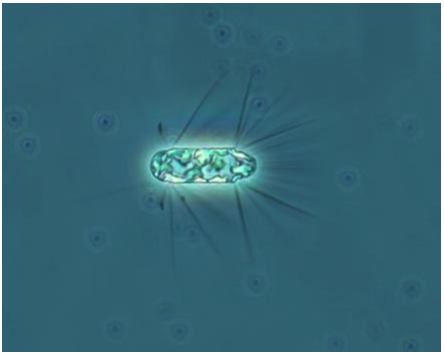
Phytoplankton samples were collected on October 17, 2024 at Bullock’s Reach and analyzed in the laboratory shortly after collection. It was windy and brisk on Narragansett Bay. Sonde data revealed the surface water temperature was 14.63°C, salinity was 30.01 psu, and chlorophyll a was 2.58 ug/L. The qualitative tow net sample had a quick filtration time and the filtrate was clear. The analysis of the quantitative whole water sample revealed a total of 156,000 cells/L. The microflagellates were found at 48,000 cells/L. The most predominant phytoplankton genera were Prorocentrum spp. at 38,000 cells/L, Leptocylindrus spp. at 16,000 cells/L, and Cylindrotheca spp. at 12,000 cells/L. Corethron hystrix, shown here in a 200x phase contrast micrograph, is a solitary species of centric diatom found in the North Atlantic and North Pacific, typically in the spring and fall. They have a unique pill shape and two rings of long spines directed towards one end, and a crown of shorter, hooked spines pointed in the opposite direction. Although they do not bloom in large numbers, it has been observed that they may cause physical obstructions in the gills of farmed salmon.

September 11, 2024

​Water column profiles were conducted at seven locations in the Providence and Seekonk River estuaries on September 11, 2024 using a Seabird Electronics profiler. In the five days leading up to the survey, 0.02 inches of precipitation were recorded at T.F. Green. Water column stratification at the sites varied from well-mixed at Edgewood Yacht Club and Point Street Bridge, to moderately stratified at Phillipsdale Landing. 

Dissolved oxygen (DO) conditions were below the hypoxia threshold (2.9 mg/L) in the lower portion of the water column at Edgewood Yacht Club, and in the middle and lower portions of the water column at Phillipsdale Landing. The highest fluorescence readings for the week were measured around 1 meter below the surface at Phillipsdale Landing.​

October 3, 2024

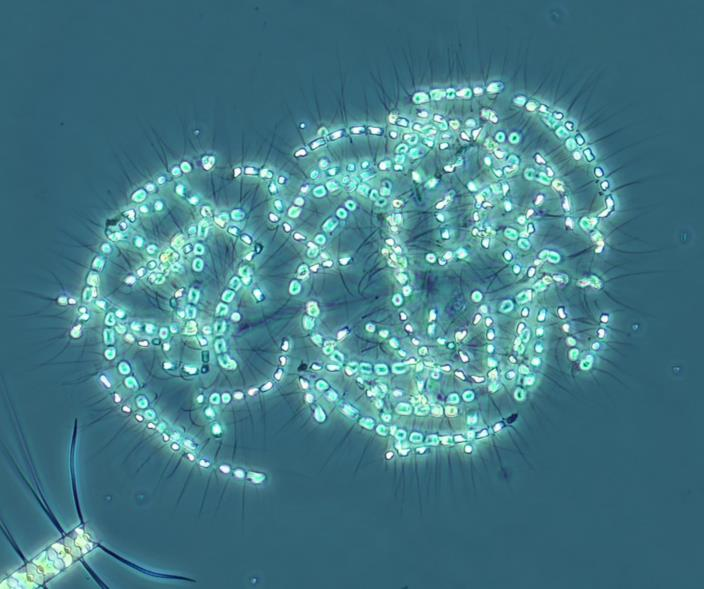
​Phytoplankton samples were collected on October 3, 2024 at Bullock’s Reach and analyzed in the laboratory shortly after collection. Weather conditions and Sonde data were not recorded on this day. The qualitative tow net sample had a quick filtration time. The filtrate was slightly cloudy and reddish brown with some particulates. The analysis of the quantitative whole water sample revealed a total of 1,712,000 cells/L. The microflagellates were found at 112,000 cells/L. The most predominant phytoplankton genera were Heterocapsa spp. at 1,232,000 cells/L, Prorocentrum spp. at 108,000 cells/L, and Leptocylindrus spp. at 100,000 cells/L. Chaetoceros socialis, shown here in a 100x phase contrast micrograph, is a species of diatom belonging to one of the most diverse genera of marine planktonic organisms. Due to their high growth rates, research on the use of Chaetoceros species in biotechnology is ongoing. They are currently used in commercial aquacultures and studies suggest that they have enormous potential for producing biofuel.

September 4, 2024

​Water column profiles were conducted at seven locations in the Providence and Seekonk River estuaries on September 4, 2024 using a Seabird Electronics profiler. In the five days leading up to the survey, no precipitation was recorded at T.F. Green. Water column stratification at the sites varied from well-mixed at Pomham Rocks, to weakly stratified at all other profiled sites.

Dissolved oxygen (DO) conditions were below the hypoxia threshold (2.9 mg/L) in the lower portion of the water column at Phillipsdale Landing, Edgewood Yacht Club, and India Point Park. The highest fluorescence readings for the week were measured around 1 meter below the surface at Pomham Rocks. ​

September 4, 2024

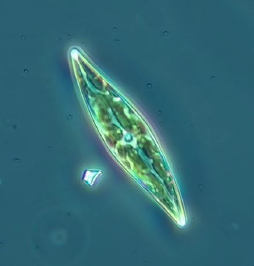
Phytoplankton samples were collected on September 4, 2024 at Bullock Reach and analyzed in the laboratory shortly after collection. ​It was a sunny, calm and cloudless day on Narragansett Bay. Sonde data was not analyzed on this day. The qualitative tow net sample had a quick filtration time, the filtrate was slightly cloudy and golden brown with some black particulates. The analysis of the quantitative whole water sample revealed a total of 874,000 cells/L. The microflagellates were found at 94,000 cells/L. The most predominant phytoplankton genera were Skeletonema spp. at 240,000 cells/L, Leptocylindrus spp. at 224,000 cells/L, and Cylindrotheca spp. at 188,000 cells/L. Pleurosigma, shown here in a 200x phase contrast micrograph, is a widely distributed genus of elongate, biraphid diatoms which glide and rotate in brackish to marine waters. They are pelagic and either float on the tides, sink to lower levels on top of the salt layer or attach to marine organisms. These diatoms contribute to essential oxygen levels in the ocean and also serve as a food source for animal larvae and dinoflagellates.​​

Scroll to Top