Water clarity was measured at three locations in the Providence River and Seekonk River estuaries on August 13, 2025. Due to an equipment malfunction, only a limited number of sites were visited during this sampling day. In the five days prior to the survey, 0.00 inches of precipitation were recorded at TF Green. Secchi depth averaged 2.5 meters. The lowest clarity this week (2.1 meters) was measured at Edgewood Yacht Club, while the greatest clarity (3.1 meters) was measured at Conimicut Point. There was a general north-to-south trend of increasing water clarity among the sites this week. Compared to the measurements taken on July 23, 2025, water clarity at Bullock Reach and Edgewood Yacht Club remained unchanged on July 30, while Conimicut Point showed an increase in water clarity of 0.8 meters.
Phytoplankton samples were collected on July 23, 2025 at Bullock’s Reach and analyzed in the laboratory shortly after collection.
The water temperature was 23.72 °C, the salinity was 28.61 psu, and the chlorophyll a was 7.18 ug/L.
The qualitative tow net sample had a medium filtration time. The filtrate was clear with a light brown greenish coloration. Many comb jellies were detected in this sample.
The analysis of the quantitative whole water sample revealed a total of 4,386,000 cells/L. The microflagellates were found at 40,000 cells/L. The most predominant phytoplankton genera were Cylindrotheca spp. at 2,055,000 cells/L, Skeletonema spp. at 860,000 cells/L, and Leptocylindrus spp. at 840,000 cells/L.
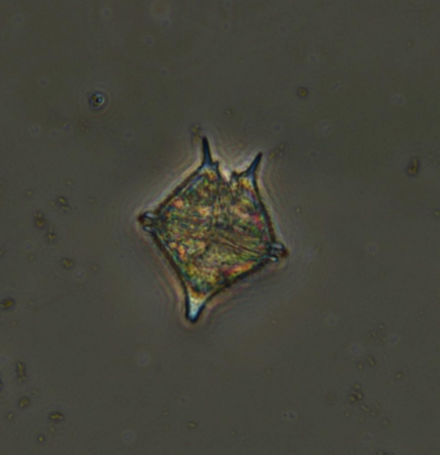
200x phase contrast image of dinoflagellate Protoperidinium spp.
Protoperidinium spp. is a marine phytoplankton belonging to a family of armored dinoflagellates that are characterized by horns and spikes. They are heterotrophic predators who feed on other smaller organisms for nutrients. With the help of chloroplasts, these tiny creatures can produce their own nutrients with photosynthesis.
On August 13th, 2025, twenty stations were sampled for fecal coliform bacteria in the Providence and Seekonk Rivers; five of these stations were also sampled for enterococci bacteria. There was no precipitation at TF Green over the five days prior to the August 13th, 2025 sampling event. Overall bacteria counts were lower than during the previous sampling event.
Fecal coliform counts were higher in the Seekonk River, compared to the Providence River (geometric mean of 25 MPN/100 mL for the Seekonk River compared to 7 MPN/100mL for the Providence River) for sampling conducted on August 13th. The maximum count (93 MPN/100 mL) was measured at the Division St. Dock, Bishop Point, and Collier Point Park sampling locations.
Fecal coliform counts remained approximately the same in the Providence River, compared to the previous sampling on July 30th (geometric mean of 7 MPN/100 mL compared to 9 MPN/100 mL on 7/30). Fecal coliform counts were lower in the Seekonk River, compared to the previous sampling on July 30th (geometric mean of 25 MPN/100 mL compared to 55 MPN/100 mL on 7/30).
Enterococci results had an overall geometric mean of 11 MPN/100 mL. Enterococci counts ranged from <10 MPN/100 mL at most sites to 20 MPN/100 mL at Point Street Bridge.
The next scheduled sampling date is August 27th.
The table below lists the Rhode Island bacteria standards for primary contact and shellfishing established by the Rhode Island Department of Environmental Management (RIDEM). RIDEM defines primary contact as any recreational activities in which there is prolonged and intimate contact with water, involving considerable risk of ingesting water (e.g., swimming, diving, water skiing and surfing). Please note that the RIDEM bacteria standards are provided here for informational purposes only and are not intended to indicate official state compliance with primary contact or shellfishing standards.
Summary of Rhode Island Bacteria Standards for Saltwater Primary Contact and Shellfishing
Geometric mean ≤35 colonies/100 mL All samples ≤104 colonies/100 mL2
Shellfishing
Geometric mean ≤14 MPN/100 mL <10% of samples >49 MPN/100 mL3
NO ENTEROCOCCI CRITERIA
1Fecal coliform primary contact criteria applied only when adequate enterococci data are not available; 2Single sample maximum criterion for determining beach swimming advisories at designated beaches as evaluated by the Rhode Island Department of Health; 3For a three-tube decimal dilution.
Phytoplankton samples were collected on July 8, 2025 at Bullock’s Reach and analyzed in the laboratory shortly after collection.
It was sunny, hot, and humid on this day. The water temperature was 25.24 °C, the salinity was 27.85 psu, and the chlorophyll a was 5.55 ug/L.
The qualitative tow net sample had a quick filtration time. The filtrate contained seaweed and particulates and had a reddish brown coloration.
The analysis of the quantitative whole water sample revealed a total of 875,000 cells/L. The microflagellates were found at 268,000 cells/L. The most predominant phytoplankton genera were Prorocentrum spp. at 284,000 cells/L , and Thalassiosira spp. at 198,000 cells/L.
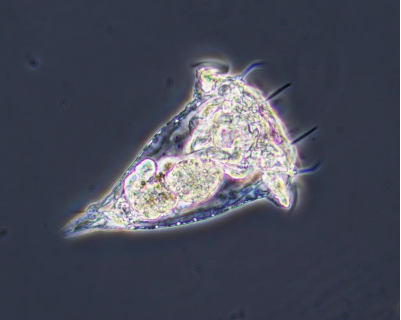
200x phase contrast micrograph of Monogonontan Rotifer
Rotifers of the subclass Monogononta are common metazoans found in freshwater, brackish and marine environments. Although they are small, ranging in size from 50–500 µm, they are extremely important in the transfer of energy from algae, microbes, and detritus to higher trophic levels in community food webs.
On July 30th, 2025, twenty stations were sampled for fecal coliform bacteria in the Providence and Seekonk Rivers; five of these stations were also sampled for enterococci bacteria. In the five days prior to sampling, 1.91 inches of precipitation was recorded at TF Green. Overall bacteria counts were lower than during the previous sampling event.
Fecal coliform counts were higher in the Seekonk River, compared to the Providence River (geometric mean of 55 MPN/100 mL for the Seekonk River compared to 9 MPN/100mL for the Providence River) for sampling conducted on July 30th. The maximum count (930 MPN/100 mL) was measured at the Point St. Bridge sampling location.
Fecal coliform counts were lower in the Providence River, compared to the previous sampling on July 16th (geometric mean of 9 MPN/100 mL compared to 16 MPN/100 mL on 7/16). Fecal coliform counts were lower in the Seekonk River, compared to the previous sampling on July 16th (geometric mean of 55 MPN/100 mL compared to 82 MPN/100 mL on 7/16).
Enterococci results had an overall geometric mean of 14 MPN/100 mL. Enterococci counts ranged from <10 MPN/100 mL at most sites to 109 MPN/100 mL at Point St. Bridge.
The next scheduled sampling date is August 13th.
The table below lists the Rhode Island bacteria standards for primary contact and shellfishing established by the Rhode Island Department of Environmental Management (RIDEM). RIDEM defines primary contact as any recreational activities in which there is prolonged and intimate contact with water, involving considerable risk of ingesting water (e.g., swimming, diving, water skiing and surfing). Please note that the RIDEM bacteria standards are provided here for informational purposes only and are not intended to indicate official state compliance with primary contact or shellfishing standards.
Summary of Rhode Island Bacteria Standards for Saltwater Primary Contact and Shellfishing
Geometric mean ≤35 colonies/100 mL All samples ≤104 colonies/100 mL2
Shellfishing
Geometric mean ≤14 MPN/100 mL <10% of samples >49 MPN/100 mL3
NO ENTEROCOCCI CRITERIA
1Fecal coliform primary contact criteria applied only when adequate enterococci data are not available; 2Single sample maximum criterion for determining beach swimming advisories at designated beaches as evaluated by the Rhode Island Department of Health; 3For a three-tube decimal dilution.
Water clarity was measured at eight locations in the Providence River and Seekonk River estuaries on July 30, 2025. In the five days prior to the survey, 1.91 inches of precipitation were recorded at TF Green. Secchi depth averaged 2.2 meters. The lowest clarity this week (1.5 meters) was measured at Phillipsdale Landing and Pawtuxet Cove, while the greatest clarity (3.7 meters) was measured at Point Street Bridge. There was no clear north-to-south gradient in water clarity among the sites this week. Overall, water clarity remained approximately the same from the previous measurements (data collected July 23, 2025).
Water clarity was measured at seven locations in the Providence River and Seekonk River estuaries on July 23, 2025. In the five days prior to the survey, trace amounts of precipitation were recorded at TF Green. Secchi depth averaged 2.0 meters. The lowest clarity this week (1.7 meters) was measured at Edgewood Yacht Club and Pomham Rocks, while the greatest clarity (2.5 meters) was measured at Bullock’s Reach. There was no clear north-to-south gradient in water clarity among the sites this week. Overall, water clarity remained approximately the same from the previous measurements (data collected July 16, 2025).
On July 16th, 2025, seventeen stations were sampled for fecal coliform bacteria in the Providence and Seekonk Rivers; five of these stations were also sampled for enterococci bacteria. In the five days prior to sampling, 0.01 inches of precipitation was recorded at TF Green. Overall bacteria counts were lower than during the previous sampling event.
Fecal coliform counts were higher in the Seekonk River, compared to the Providence River (geometric mean of 82 MPN/100 mL for the Seekonk River compared to 16 MPN/100mL for the Providence River) for sampling conducted on July 16th. The maximum count (430 MPN/100 mL) was measured at the India Point Park sampling location.
Fecal coliform counts were lower in the Providence River, compared to the previous sampling on July 2nd (geometric mean of 16 MPN/100 mL compared to 49 MPN/100 mL on 7/2). Fecal coliform counts were lower in the Seekonk River, compared to the previous sampling on July 2nd (geometric mean of 82 MPN/100 mL compared to 4916 MPN/100 mL on 7/2).
Enterococci results had an overall geometric mean of 11 MPN/100 mL. Enterococci counts ranged from <10 MPN/100 mL at most sites to 20 MPN/100 mL at Point St Bridge.
The next scheduled sampling date is July 30th.
The table below lists the Rhode Island bacteria standards for primary contact and shellfishing established by the Rhode Island Department of Environmental Management (RIDEM). RIDEM defines primary contact as any recreational activities in which there is prolonged and intimate contact with water, involving considerable risk of ingesting water (e.g., swimming, diving, water skiing and surfing). Please note that the RIDEM bacteria standards are provided here for informational purposes only and are not intended to indicate official state compliance with primary contact or shellfishing standards.
Summary of Rhode Island Bacteria Standards for Saltwater Primary Contact and Shellfishing
Geometric mean ≤35 colonies/100 mL All samples ≤104 colonies/100 mL2
Shellfishing
Geometric mean ≤14 MPN/100 mL <10% of samples >49 MPN/100 mL3
NO ENTEROCOCCI CRITERIA
1Fecal coliform primary contact criteria applied only when adequate enterococci data are not available; 2Single sample maximum criterion for determining beach swimming advisories at designated beaches as evaluated by the Rhode Island Department of Health; 3For a three-tube decimal dilution.
Water clarity was measured at seven locations in the Providence River and Seekonk River estuaries on July 16, 2025. In the five days prior to the survey, 0.01 inches of precipitation were recorded at TF Green. Secchi depth averaged 1.9 meters. The lowest clarity this week (1.5 meters) was measured at India Point Park, while the greatest clarity (2.5 meters) was measured at Point Street Bridge. There was no clear north-to-south gradient in water clarity among the sites this week. Overall, water clarity at most locations remained relatively consistent compared to previous measurements (data collected July 8, 2025). However, water quality at Phillipsdale Landing increased (0.8 meters) and water quality at Conimicut Point decreased (1.6 meters), both compared to previous measurements (data collected July 8, 2025).
On July 2nd, 2025, twenty stations were sampled for fecal coliform bacteria in the Providence and Seekonk Rivers; five of these stations were also sampled for enterococci bacteria. In the five days prior to sampling, 0.03 inches of precipitation was recorded at TF Green. Overall bacteria counts were higher than during the previous sampling event.
Fecal coliform counts were higher in the Seekonk River, compared to the Providence River (geometric mean of 4916 MPN/100 mL for the Seekonk River compared to 49 MPN/100mL for the Providence River) for sampling conducted on July 2nd. The maximum count (240,000 MPN/100 mL) was measured at the Point St. Bridge sampling location.
Fecal coliform counts were higher in the Providence River, compared to the previous sampling on June 4th (geometric mean of 49 MPN/100 mL compared to 30 MPN/100 mL on 6/4). Fecal coliform counts were higher in the Seekonk River, compared to the previous sampling on June 4th (geometric mean of 4916 MPN/100 mL compared to 93 MPN/100 mL on 6/4).
Enterococci results had an overall geometric mean of 333 MPN/100 mL. Enterococci counts ranged from <10 MPN/100 mL at Conimicut Point and Gaspee Point to 6488 MPN/100 mL at Point St Bridge.
The next scheduled sampling date is July 16th.
The table below lists the Rhode Island bacteria standards for primary contact and shellfishing established by the Rhode Island Department of Environmental Management (RIDEM). RIDEM defines primary contact as any recreational activities in which there is prolonged and intimate contact with water, involving considerable risk of ingesting water (e.g., swimming, diving, water skiing and surfing). Please note that the RIDEM bacteria standards are provided here for informational purposes only and are not intended to indicate official state compliance with primary contact or shellfishing standards.
Summary of Rhode Island Bacteria Standards for Saltwater Primary Contact and Shellfishing
Geometric mean ≤35 colonies/100 mL All samples ≤104 colonies/100 mL2
Shellfishing
Geometric mean ≤14 MPN/100 mL <10% of samples >49 MPN/100 mL3
NO ENTEROCOCCI CRITERIA
1Fecal coliform primary contact criteria applied only when adequate enterococci data are not available; 2Single sample maximum criterion for determining beach swimming advisories at designated beaches as evaluated by the Rhode Island Department of Health; 3For a three-tube decimal dilution.